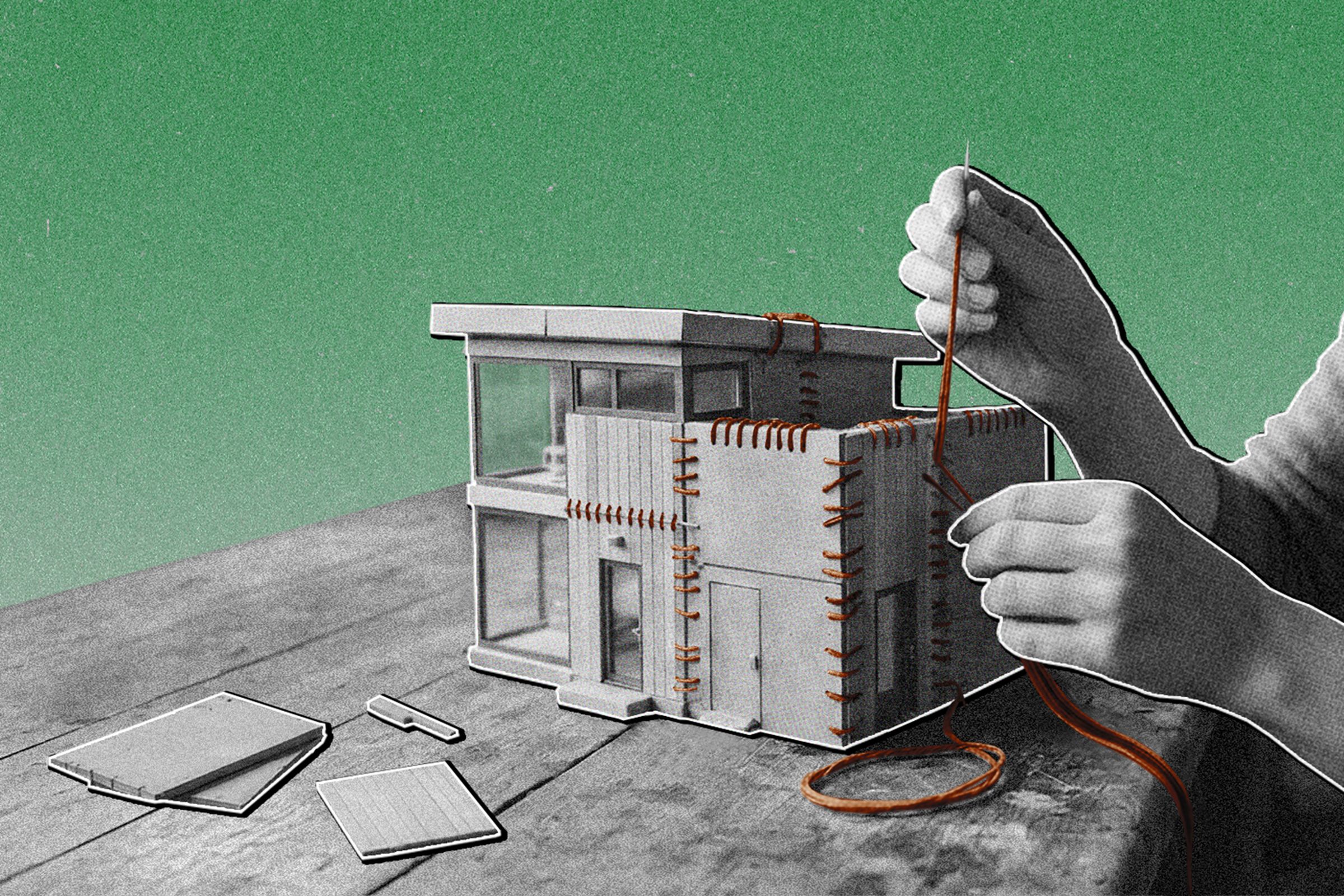

Every few years, the prefab thing raises its clunky head. Right now, we’re witnessing another such vogue, rebadged as “modern methods of construction” (MMC). Is this really the answer? Or is it just another of the misguided and slightly desperate measures – from mass rezonings and suburban skyscrapers to community exclusion and developer-led deregulation – that the affordability crisis has cloaked as common sense? Can the market actually solve this market-made problem? And will MMC actually help?
Capitalism, like democracy, is driven by desire. Economics may claim scientific neutrality but is really a swirling mass of unanalysed emotion. We are encouraged to buy and vote for not what we need, or what benefits the culture, but what we individually want. Do we, then – will we ever – want to live in factory-made dwellings? That’s the thing.
A few years back, during the tiny-house craze, everyone was talking car-space-sized mobile homes, refurbed shipping containers and other forms of prefab housing. Then we realised two things: one, the real cost of housing in cities is land cost, and even a tiny home needs to land somewhere; and two, prefabricated structures are hard to love.
In the late 1920s, Buckminster Fuller’s Dymaxion House looked like the sustainable, autonomous, mass-producible single-family house of the future. In the forties and fifties, French designer Jean Prouvé offered his ready-made steel-and-timber demountable “shacks” (1944) and mass-produced apartment building (1955). Then there were all those demountable fibro classrooms, not to mention so-called mobile homes. And this century, IKEA, Panasonic, Mitsubishi and Toyota have all had a go. But housing across the world remains stubbornly unchanged. Will MMC – or volumetric modular construction (VMC) – succeed in changing this where all else has failed?
Our governments clearly think so. In 2024, the federal government promised $900 million to enhance housing supply, with their intent to put it towards “streamlining commercial planning and zoning, and … the uptake of modern construction methods.” More recently, it announced $39 million to scale up the open-source “kit-of-parts” platform System 600. Meanwhile, Western Australia has a $50 million fund to support modular and precast production, Queensland is pushing for 50 percent prefab building on government projects in the lead-up to the Olympic Games, and New South Wales is investing $32 million over four years in a “modern building system,” including subsidising manufacturers (with grants up to $150,000). The NSW government also has an MMC taskforce, is changing the regulatory system to create “opportunities” for MMC (including VMC), and is transforming the planning system to remove entire categories of building from the public purview or any consideration of the public interest.
NSW Housing Minister Rose Jackson boldly asserts that “modern construction methods are a genuine game-changer for housing supply.” But there’s little to no evidence to date. So perhaps the resistance to prefabrication is deeper, and the influence of externalities stronger, than any of this suggests?
It is somewhat ironic that this YIMBY-backed, no-holds-barred government-developer push for “better, faster and cheaper” housing has coincided with a counter-movement towards the handmade, home skills and craft. Much of the first-home-buyer demographic that fuels the YIMBY movement has also helped to bring back into vogue a range of intensely skill-based art forms and traditional skills, from home pickling and broth-making to knitting, stitching and super-realist painting.
This dualism – probably better seen as healthy cultural tension than outright hypocrisy – has reignited the so-called craft debate, which brings a moral dimension to the question of housing efficacy. And here, too, there’s history. The Arts and Crafts movement, led by nineteenth- and early twentieth-century creative geniuses such as William Morris (1834–1896) and William Lethaby (1857–1931), made the push for handmade wallpapers, textiles, furniture and buildings into a moral and political crusade. Recognising the harms of industrialisation, they celebrated manual skill and elevated the workers from factory-fodder to honoured artisans.
Prefabrication, too, wants to champion the little guy. The holy grail of decent housing for all motivated some first-rate design minds including Fuller, Prouvé and, of course, Charles and Ray Eames.
Bridging the two camps, mid-century British architect Walter Segal designed a self-build system that gave homeowners both affordability and creative control, and was seen as a possible revolution in housing production. Yet none of this design excellence has prevented prefab homes, offices and classrooms from becoming stigmatised with perceptions of discomfort, cheapness and impermanence. Why is this?
It could be design failure. We all remember prefab classrooms being intolerably cold in winter and furnace-like in summer. We’ve all seen prefab houses with huge eye-level beams bisecting the view and comfortless built-in furniture in all the wrong places; tiny houses that feel like traps; and container homes with all the echoey ambience of a murder-fugitive’s bush hideout.
It could be economics. A major issue with MMC is that it requires massive investment upfront, in the design of both buildings and systems, and cannot become profitable before it reaches mass production, so the risk is enormous. This is why governments have so massively subsidised the MMC industry. But many prefab companies in the UK have gone broke and many councils, having found that it generated higher costs, lower quality and huge financial risk, have abandoned MMC altogether.
There’s also the question of subsidy: is it reasonable to expect an industry so dependent on government subsidy ever to become self-sufficient? Or is that just bad parenting, like tying a kid’s shoelaces instead of teaching them to do it themselves?
Or maybe it’s a question of land. A dwelling does, after all, need a site. Slightly embarrassingly, perhaps, it is just over fifty years since an Australian Government Task Force to Investigate Modern Housing Techniques (1974) found exactly this – that industrialised housing, however well intentioned, needs ongoing guaranteed demand, reliable andadequate finance for both construction and purchase, and a steady supply of serviced land. Fast forward to now, when city land, already wildly expensive, has further skyrocketed in value due to the mass upzoning that, across all our major cities, was meant to enhance affordability. Go figure.
But there are deeper questions too. Maybe the problem with prefab is more about human psychology than practicality. Maybe it goes to that old desire thing – what we value, and what we want.
We value what is difficult. We are instinctively drawn to a Victor Horta staircase, with its intricately curling metalwork filigree; to Peter Zumthor’s Bruder Klaus Field Chapel, with its 24 visible rungs of concrete, poured monk-like every 24 hours, and its burned-out log interior; or to the lovely terracotta and faience that were pretty standard in even quite modest commercial buildings of the nineteenth century. That attraction is an instinctual and perhaps subliminal acknowledgement of invested human energy and skill.
Consider how realism in art lost value with the invention of the camera, or how virtuoso graphics have been devalued by artificial intelligence. Sure, we want things easy. But as soon as a thing actually becomes easy to generate or acquire, we lose interest, and it loses value.
Proponents of MMC are very big on its practical advantages. Factory-based construction is all-year and all-weather. It is more efficient with both materials and energy, and it can make more intensive use of digital and robotic techniques, so there are fewer staffing issues – all of which is great.
But many a modern innovation has foundered on its failure to recognise just what odd and complicated creatures we are. We are not robots. Efficiency is a wildly overrated god and flawless build precision is not a part of most people’s dreaming. Our affection for the handmade, the slightly wonky, the brick-by-brick and stick-by-stick approach to building a house is not just Luddite conservatism. Perhaps it says something innate about us. We’re not especially rational. We pursue what we want, admire and love – and mostly, that’s the deep investment of other humans.