
Australian cities are undergoing an epochal transformation thanks to a series of mobility infrastructure projects that will reorganise how our cities function, and, indeed, help define how sustainable they will be in the future.
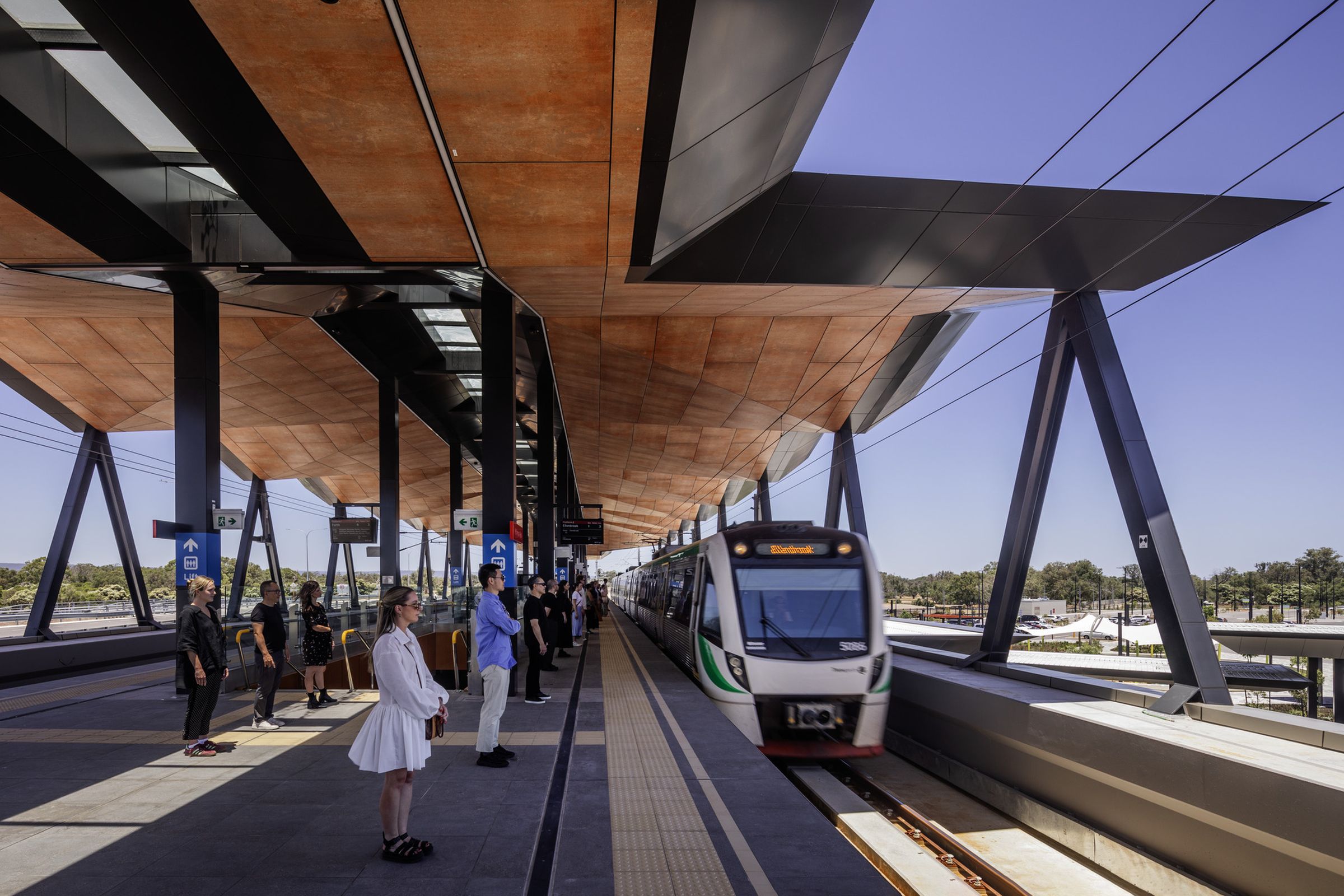
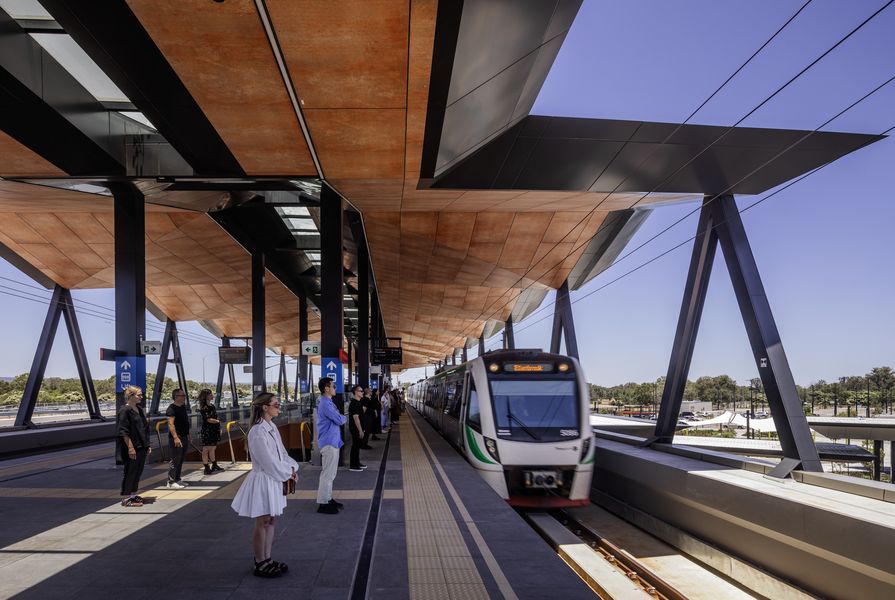
Major rail projects are active or recently completed in many capital cities. Perth has the Metronet plan, with the Morley–Ellenbrook Line Project recently completed (now called the Ellenbrook Line). Sydney’s Metro City Line is complete, and the network is continuing to grow, with the planned Western Sydney Airport link and Metro West underway, while in Brisbane, works associated with the major Cross River Rail project are opening. These join Melbourne’s recently completed Metro Tunnel project and future Suburban Rail Loop.
Why are we experiencing this boom in rail projects, and what are the implications for our cities? Rail projects have historically occurred in bursts of activity, each with a distinct impact on a city’s growth. The earliest steam rail projects of the nineteenth century created industrial corridors in their cities as they connected mines and factories to ports. Later, commuter-focused national and transcontinental rail projects led to grand civic terminals that reshaped their cities around them. Electrification resulted in an era of metropolitan rail in global cities, contributing to the decentralisation of urban living. But after the arrival and accessibility of the private automobile, cities rushed to “modernise” with highway and freeway infrastructure, leading to a precipitous decline in rail investment through the second half of the twentieth century (other than isolated investment in high-speed rail in western Europe and Japan).
The twenty-first century’s imperative to minimise the impact of climate change brought on a new era of rail investment in many developed countries. This boom is led by a low-emissions philosophy aligned with planning concepts including transit-oriented development, rail-led densification, and city visions of a car-free future. Recent major global rail projects such as London’s Elizabeth Line, Paris’s Grand Paris Express, and New York’s East Side Access were instigated with these same philosophical underpinnings.
The Australian experience has been similar: following half a century of under-investment, the efficiency of rail as urban transportation has driven the alignment of political will needed for a massive capital investment. The current Australian projects can be broadly categorised into three types: radial extensions to the network, capacity additions, and orbital or loop connections. Each has a distinct impact on the city.
Radial extensions aim to connect previously underserviced areas of a city, either via a new line or an extension, and usually contemplate increased density at new transport nodes. Perth Metronet’s Ellenbrook Line is an example of a linear radial extension planned with dense “urban villages” at stations. It forms part of a comprehensive transport vision of 72 kilometres of new rail, designed to improve connectivity. This vision currently reinforces Perth’s monocentric CBD with growth corridors through a series of radial extensions (with the exception of the planned Thornlie-Cockburn Link orbital connection).
The capacity addition, in which a new line is constructed to run parallel to an existing one, aims to increase capacity and remove bottlenecks in the system, while also facilitating additional density. Brisbane’s Cross River Rail and the Sydney Metro City Line are both capacity additions, alleviating the limitations of a single river or harbour crossing in their respective cities with a new line through the city centre. Both projects contemplate over-station or integrated-station developments as an opportunity to increase density within their city centre contexts, and each has taken a different approach.
Cross River Rail strategically decoupled the development opportunities from the rail infrastructure, providing long-term flexibility of development type and timing. In contrast, Sydney Metro’s CBD projects completely integrated over-station and station development, whereby the rail infrastructure and over-station opportunities are structurally interdependent.
The third typology is the orbital or loop connector, which provides a circumferential connector around a city centre connecting radial rail lines. This type is designed to decrease congestion in the city centre by allowing movement between suburban areas without the need to pass through the centre. These orbital connectors have the potential to create “super-nodes” of density where the loop line crosses the radial line, thus not only restructuring movement around the city, but also fundamentally changing the city’s form. It comes as cities transition from a monocentric to a polycentric urban form.
In Australia, Melbourne’s Suburban Rail Loop (SRL) plan is an obvious example of this – a 90 kilometre orbital project threading through existing suburbs. The plan will be realised in three sections, ultimately connecting with Melbourne Airport. The first section, SRL East, includes plans for six underground stations and connects Melbourne’s south-eastern suburbs with campuses for Monash University and Deakin University. Each station precinct has been planned to accommodate additional density, creating a new “ring” of transport-connected nodes around the CBD.
SRL, along with planned projects like the Sydney Metro Western Sydney Airport line – part of Sydney’s decentralisation vision – are part of the next generation of urban growth as cities move away from a disconnected city to a networked one. It’s a transition Christopher Alexander would categorise as a move from the “tree” structure of an artificially organised city, to the “semi-lattice” of a natural one.1
Australia’s twenty-first-century investment in transport infrastructure is transforming our cities to be more sustainable and less reliant on cars. Architects are playing a major design role, from route design and masterplanning to designing stations and their surrounding urban precincts. This is possibly the biggest investment in urban transformation since the postwar era’s introduction of freeways into our cities, and, if it continues, it will leave a legacy of low-carbon Australian cities.
Read the case studies:
Cross River Rail by Hassell
Metronet Morley–Ellenbrook Line Project by Woods Bagot with TRCB Architects, TCL and UDLA
– Philip Vivian is managing director of Bates Smart, based in the Sydney studio. He is a contributing writer to Architecture Australia and president of the Council on Vertical Urbanism (Australia).
(1) Christopher Alexander, “A city is not a tree,” Architectural Forum , vol. 122, no. 1, April 1965.
Source
Projects
Published online: 23 Nov 2026
Words:
Philip Vivian
Images:
Trevor Mein
Issue
Architecture Australia, November 2026