

Public sector roles constitute an important avenue for the diversification of career pathways for architects. Yet there are few models for career paths involving public sector work visible in the profession. This dossier mentions several examples through which architects are being connected with public sector career opportunities, including through secondments and internships. However, there is a strong argument for addressing this occlusion at the point of professional education and making career pathways involving public sector work more visible to students. While practice-based experience is an integral part of the pathway to professional registration in Australia, increasingly, universities are being encouraged to provide work-integrated learning and to explicitly address the employability of graduates. This is also an opportunity to shape broader cultural change in the profession. The following article by Moore, Fergus and Dodd describes the Public Practice course they delivered at Monash University to address this opportunity. As they explain, their teaching exposes students to diverse examples of public practice careers through direct contact with architects and designers working in the public sector.
— Susan Holden and Kirsty Volz
Ask any student why they chose to study architecture, and they’re likely to say that they’re driven by a civic responsibility and the desire to make a better world by solving issues of social justice, climate change, colonization and economic inequity. But upon entering the workforce, graduates can find that project outcomes are a fait accompli, already shaped by market forces, and this lack of agency can lead to latent frustration at best, or resignment at worst.
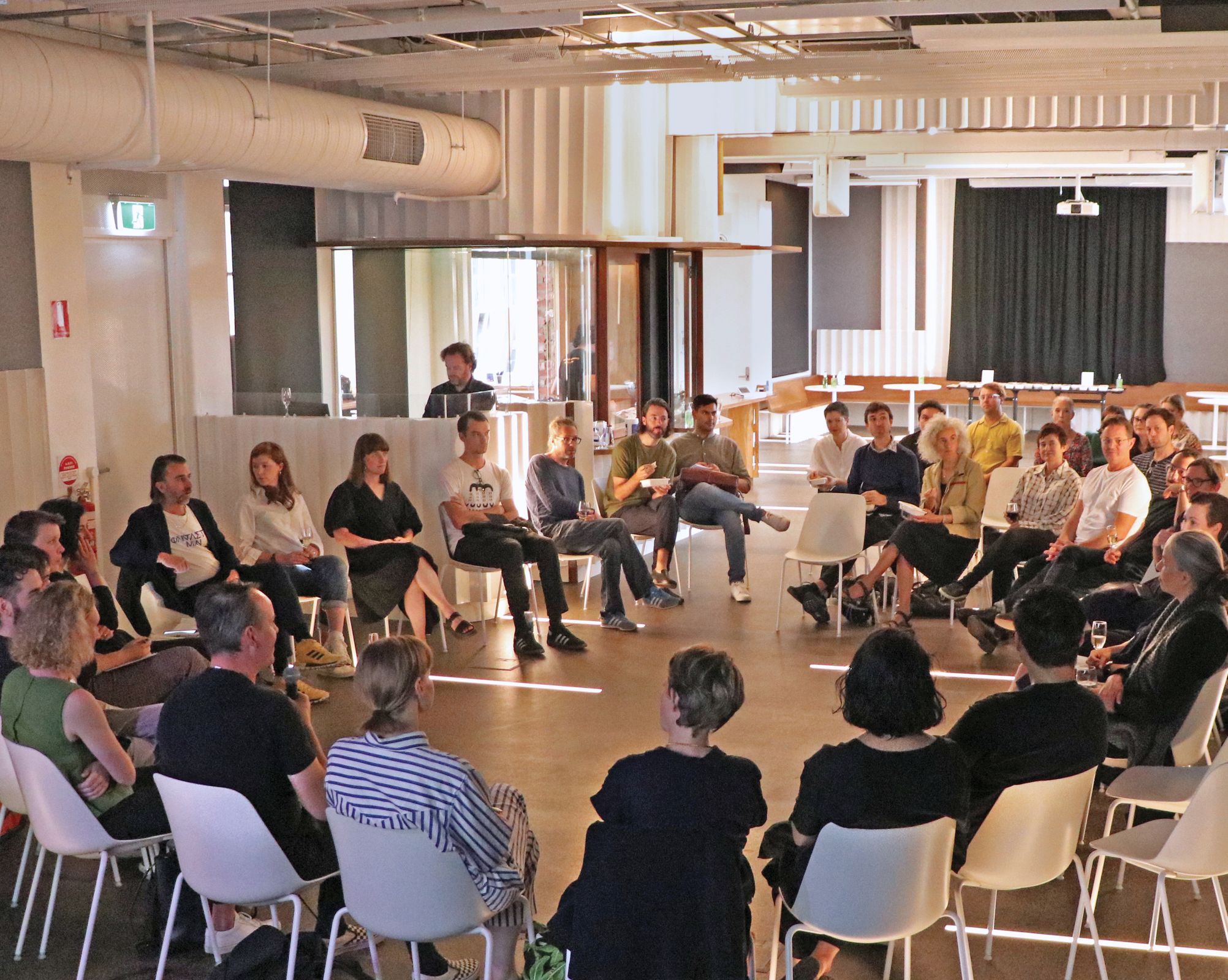
The dissonance between pedagogy and practice was the inspiration behind the elective subject Public Works taught in the master of architecture program at Monash University in 2021. The subject investigated the role of architects and designers in the public sector, and how they can influence the built environment.1 We aimed to find career pathways for graduates to work “upstream” in the design process – a location where briefs are constructed, budgets are drawn, and good design is both advocated for and enforced. The aim was to equip students to sit at the decision-making table2 because being involved in defining the problem is as important as designing the solution.
The UK social enterprise Public Practice (PP) was an important reference point for our investigation. PP brokers the placement of built environment professions in strategic roles in the public sector, and its employment model has received widespread acclaim for its ability to effectively deploy professional talent and at the same time build skills and capacity in local government. In a discussion with PP co-founder Finn Williams, we found that several Australian government architects, academics and policy advisors had inquired with PP over preceding years about starting a chapter in Australia. We wanted to understand why this had not happened yet and what this model might look like in an Australian context.
The existence of highly skilled built environment professionals in local and state government as upstream designers is not an issue in metropolitan cities around Australia. We had the opportunity to engage with a number of talented architects, urban designers and land-scape architects working in local and state government in expansive, strategic roles. Although not always visible, they can be found as city or state government architects, councillors, design advocates, design excellence managers, strategic designers, urban designers, project managers and design advisors.
However, the lack of visibility of upstream designers is an issue when connecting students to these career pathways. From more than a dozen interviews between professionals and students, along with talks in class by architects who have held senior positions in government,3 it is clear that these careers are nonlinear and enriched by diverse and contextual experiences. Those in them tend to have spent several years in the private sector – sometimes on large infrastructure delivery projects, often with government as the client – before entering the public sector. Some have shifted in and out of their public role. Some have a foot in both sectors. One architect advised students to “look out for the sliding doors moment in your career.”
The Public Works subject revealed the potential of a nonlinear career path and introduced the knowledge, skills and tools required for working upstream, including the ability to leverage advocacy, investment and regulation in the pursuit of “the codification of public benefit.”4 Students were exposed to many avenues to influence development, including coordinating incentives such as density bonuses, developer contributions and value capture; capacity building through design reviews, advisory and advocacy; and developing design policies that can influence market behaviour, including guidelines, frameworks and protocols. Olivia Hyde, Director of Design Excellence at the Government Architect NSW, described herself to the students as a magpie collecting various tools and experiences to bring breadth to her work. If you marginalize yourself to a narrow skill-set, she explained, then you narrow the issues you can influence.5
At the commencement of the subject, students were asked to chart their imagined career, upon graduation. Most described their dreams of working for small, award-winning practices in residential architecture before starting up their own office. At the end of the subject, the students were asked to reflect on their future career again. The results were extraordinarily different. Many students threaded together a career with “sliding doors” moments between work on residential projects; with firms focused on civic architecture and community engagement, in public sector roles; and with time out for significant life moments like parental leave. Faced with a future that will inevitably be complex, messy and surprising, the skills of the upstream designer grounded students in this uncertainty with multi-scalar and -disciplinary skills.
More broadly, the Public Works subject identified the need to develop collective knowledge about upstream designers, their skills and experience, and to make public practice more visible.6 One way this gap is being addressed in the UK is by providing time for Public Practice associates to undertake and publish independent research. Another avenue is for universities to provide more support through student placements or work-integrated learning that expose students to alternative practices and career paths. The need for more work-integrated learning speaks to the broader need to educate future architects with a more outward-facing agenda. The Public Works subject was a first step toward overcoming a “one size fits all” approach to training architects and a way to disrupt rigidly professionalized pathways.
In fact, there are many pathways that architects can take to have a positive impact on the quality of public buildings and places. Tracking the careers of upstream designers in the public sector provided students with examples of diverse career pathways, and pragmatic and tangible actions to effect change for the public good. At the very least, it equipped them to understand ways that their private careers will benefit from knowledge of public policy and good design guidelines, and a sense of their own agency as future professionals. It demonstrated that roles that are currently considered at the very edges of the discipline of architecture can, in fact, be found at the very centres of power. The “edginess” of these pathways suggests why a model like Public Practice has not yet emerged in Australia: the role of the upstream designer is not mainstream in architectural schools or the profession. It deserves attention so that students do not learn about a possible future of practice through osmosis alone, but through an education with clear intent.
1. Students in Public Works were: Hayden Brown, Micah Carganilla, Edward Cavarsan, Danielle Pozzebon, Sophia Hawkins, Yen-ju Benjamin Pan, Natalie Spivak, Olivia Besim, Tung Cao Vo, Thomas Heath, James Kendall, Hon Kuan Ng, Aidan White, Hannah Pisano, Ali Hashemian, Wendy Lin, Tiernan Lacey, Lindita Krasniqi, Teresa Nguyen and Nathan Louey.
2. Finn Williams, “Designing upstream: Rebuilding agency through new forms of public practice,” Architectural Design , vol. 88 no. 5, September 2018, 104–109; doi.org/10.15407/emodel.43.04.113.
3. Professionals interviewed by the students included: Clare Easterbrook-Lamb, Shwiti Ravisankar, David Morison, Justin Kelly, Clara Friedhoff, Jonathan Daly, Guy Pinkerton, Laurence Dragomir, Mai Luu, David Brand, Maggie Lokic, Elysia Craven and Cara Wiseman. Talks were delivered by: Kim Crestani, Melanie Dodd, Rory Hyde, Olivia Hyde, Gill Matthewson, Anita Morandini, Sarah Lynn Rees, Katherine Sundermann and Bill Tsakalos.
4. Ben Peake, “Towards the public interest: The role of architects and citizens in making the city for the common good,” Byera Hadley Travelling Scholarships Journal Series (Sydney: NSW Architects Registration Board, 2017), 5.
5. Olivia Hyde, “How architects can really change the world,” Public Works elective: On being a bureaucrat (Melbourne: Monash University, 18 March 2021, virtual).
6. To enhance understanding of the role and expertise of the upstream designer, we need to build on the research work of Freestone, Davison and Hu. See Robert Freestone et al., Designing the Global City: Design Excellence, Competitions and the Remaking of Central Sydney (Singapore: Palgrave Macmillan, 2019).